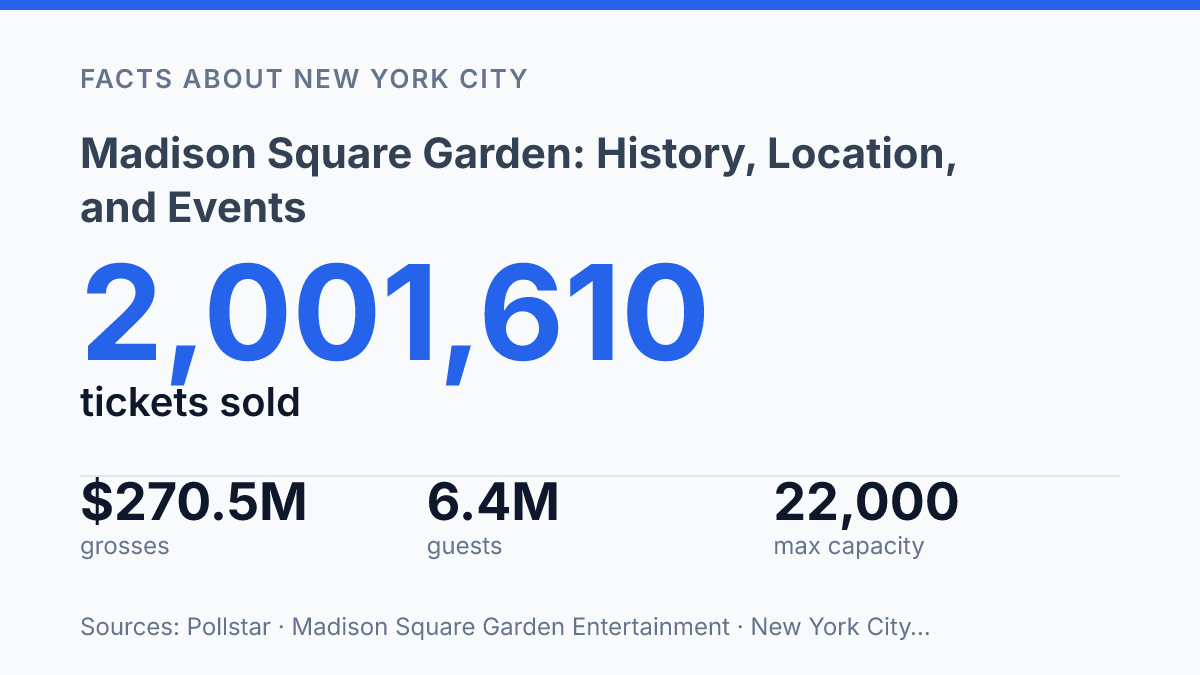
Madison Square Garden sold 2,001,610 tickets across 142 performances in Pollstar’s 2024 year-end ranking, making it the world’s No. 1 arena by ticket sales. That scale helps explain why the arena is treated as more than a familiar Midtown address: it is a working piece of New York’s event economy, tied to Penn Station, professional sports, major concerts, and city land-use decisions. The current building, completed in 1968 after a 1963 special permit, also carries the legacy of earlier Gardens, including the 1925 arena farther uptown on Eighth Avenue.
Its location above one of the country’s busiest rail hubs is central to how it functions, with city records estimating that as many as 59% of patrons arrive by subway or rail. The story of the Garden is therefore partly architectural, partly logistical, and partly political.
What makes Madison Square Garden a New York landmark?
Pollstar ranked Madison Square Garden as the world’s No. 1 arena by ticket sales in its 2024 year-end ranking, with 2,001,610 tickets sold across 142 reported performances. That commercial scale helps explain why the venue is treated as more than a neighborhood arena: it is a recurring national stage for sports, concerts, comedy, and other major indoor events in the center of New York City.
Commonly called the Garden or MSG, the arena is a multi-purpose indoor venue in Midtown Manhattan. Its identity is closely tied to location as much as programming, because it sits directly above Pennsylvania Station, one of the city’s most important rail and subway hubs. This placement gives the venue a level of regional access that few arenas can match, connecting event crowds to commuter rail, intercity rail, and multiple subway routes within the same complex.
The same centrality also explains why the site attracts civic scrutiny. A 2023 New York City Council record estimated that up to 59% of arena patrons arrive by subway or rail, which reinforces the venue’s dependence on mass transit rather than private car access. High transit use supports large event attendance in a dense part of Manhattan, but it also means arena operations intersect with station circulation, pedestrian movement, security planning, and tightly timed event schedules.
As a landmark, MSG is therefore recognisable for three linked reasons: its sustained draw as a high-volume entertainment venue, its shorthand cultural identity as “the Garden,” and its physical position over Penn Station. The combination makes it both a destination and a piece of Midtown infrastructure, which is why discussions about the arena often extend beyond events to the daily function of the surrounding transit district.
Where is the arena located in Midtown?
A single Midtown block contains an arena, a rail terminal, and multiple street entrances, which makes the site easier to locate on a map than to navigate at ground level. The arena is located between Seventh and Eighth avenues and extends from 31st to 33rd streets, occupying the large superblock immediately south of Herald Square. Its most useful street-level reference points are the numbered cross streets: West 31st Street forms the southern edge, West 33rd Street forms the northern edge, Seventh Avenue is to the east, and Eighth Avenue is to the west.
The site is directly above Penn Station in the block south of Herald Square, so the building functions as both a destination and the visible top layer of a major transportation complex. That vertical arrangement explains why wayfinding can feel less straightforward than Manhattan’s grid implies. Someone approaching from the street may be looking for an arena entrance, while someone arriving by train may first move through concourses, corridors, and station exits before reaching the same address.
The property’s scale also affects how the location reads in Midtown. According to the New York City Planning Commission in 2013, the site occupies about 246,748 square feet, with long frontages on West 31st and West 33rd streets and a substantial frontage along Eighth Avenue.
In practical terms, the venue is not a single doorway destination but a full-block complex with several edges, each connecting differently to sidewalks, transit entrances, and surrounding office and commercial streets. The address may be simple, but the layered rail-and-arena setting is the reason the surrounding block often functions more like an interchange than a conventional Midtown corner.
How did the current arena replace earlier versions?
The fourth Garden kept a 19th-century name while abandoning the square that created it. The current arena is not the first building to carry the Madison Square Garden name; the title originated with venues tied to Madison Square, near Madison Avenue and 26th Street, before the brand moved through later Manhattan sites. That continuity can make the history sound simpler than it was, because the present building belongs to a different urban logic than the early halls that gave it its name.
Earlier Gardens were linked to changing entertainment districts rather than to a single permanent structure. The first two were associated with the Madison Square area, where the name had a literal geographic meaning.
A later version operated farther uptown on Eighth Avenue between 49th and 50th streets from 1925 to 1968, with a reported capacity of about 20,000, according to National Park Service historical material. That third arena was demolished after the replacement opened several blocks south, marking a shift from a venue named for its original neighborhood to a venue identified by a transferable New York entertainment brand.
The modern building opened in 1968 on the Penn Station site, following a 1963 special permit that allowed a maximum arena capacity of 22,000 seats for a 50-year term. This move matters because it placed the arena within the city’s rail infrastructure rather than beside the square that had supplied the name. The result was a building whose identity combined inherited cultural recognition with a location shaped by commuter access, regional rail, and dense Midtown circulation.
That inherited identity has proved unusually durable. In its 2024 year-end ranking, Pollstar listed the arena as the world’s No. 1 by ticket sales, with 2,001,610 tickets sold across 142 reported performances and $270.5 million in grosses; Sebastian Maniscalco was the largest reported draw, with 93,561 fans over five nights. Those figures do not explain the replacement itself, but they show how the name survived repeated relocations and became attached most powerfully to the 1968 structure.
What kinds of events are held there today?
A typical pre-pandemic year at the arena involved about 235 events per year, a pace that helps explain why it remains one of Manhattan’s most heavily used indoor venues. A 2023 New York City Council permit record described an annual mix dominated by professional sports and concerts, with pro sports accounting for 48% of events and concerts 38%. That balance shows that the building is not dependent on a single category of programming; its calendar is structured around recurring team schedules, touring acts, and one-off live productions.
Professional basketball and hockey provide the venue’s most regular anchor dates. It is home to the New York Knicks of the NBA and the New York Rangers of the NHL, so the building’s event year is shaped by league calendars, preseason games, regular-season home stands, and possible playoff dates. Those franchises also give the arena a continuing role in daily New York sports coverage, because the venue is not only a site for occasional spectacles but a working home court and home ice across much of the year.
Concerts and large-scale live performances fill much of the remaining calendar. The venue is built to accommodate major touring productions, awards-style events, comedy shows, combat sports, college basketball, and other high-attendance formats that require an arena rather than a theater or club. MSG Entertainment reported in its 2026 Form 10-K that its venue portfolio, including this arena, hosted approximately 6.4 million guests at nearly 960 events in fiscal year 2026, a broader figure that illustrates the operating scale behind its entertainment business.
The same density that keeps the arena culturally visible also narrows the window for major operational changes. A packed schedule supports revenue, media attention, and civic familiarity, but it leaves limited downtime for intrusive maintenance, renovations, or logistical adjustments that would disrupt events. That tension is part of the venue’s present-day identity: it remains relevant because it is constantly in use, and that constant use makes even routine changes more complicated to plan.
Why the site will keep shaping the debate
The arena’s future is likely to be judged less by sentiment than by what the site can justify in a constrained part of Midtown. A venue that draws millions of visitors has clear economic and cultural value, but its position over Penn Station makes every permit, renovation plan, and public subsidy part of a wider transportation question.
The $45 million real-estate tax exemption reported for fiscal 2026 gives that debate a measurable public cost, not just a symbolic one. As New York weighs event capacity against station access, the defining issue may be whether a privately operated arena can continue to occupy public attention, public infrastructure, and public tax policy on the same block.
Frequently Asked Questions
Q: Where is Madison Square Garden located in New York City?
A: Madison Square Garden is in Midtown Manhattan, New York City, between Seventh and Eighth avenues and from 31st to 33rd streets. It sits atop Pennsylvania Station, which is a major transportation hub. That location makes it one of the most centrally placed large indoor venues in Manhattan.
Q: Why is Madison Square Garden called “the Garden”?
A: The name “the Garden” is a long-standing nickname for Madison Square Garden. It is commonly used in media coverage, event listings, and everyday conversation. The shorter form reflects how widely recognized the venue is.
Q: What kind of venue is Madison Square Garden?
A: Madison Square Garden is a multi-purpose indoor arena. That means it is designed to host different types of events in one facility, rather than serving a single sport or use. Its flexibility is a major reason it remains active across many event categories.
Q: What events are usually held at Madison Square Garden?
A: Madison Square Garden hosts a mix of sports, concerts, and live entertainment events. Multi-purpose arenas are typically scheduled to accommodate changing setups, which allows the venue to support a broad calendar. This makes it one of the most heavily used indoor event spaces in New York City.
Q: Why is Madison Square Garden considered an important New York venue?
A: Madison Square Garden is important because of its location, scale, and event range. Being in Midtown Manhattan above Pennsylvania Station gives it strong transit access, which helps draw large audiences. Its long-standing role as a major indoor arena also gives it significant cultural visibility.